

Honoring Rappi, Banco do Brasil, and Leaders from Atlas Renewable Energy, LATAM Airlines
News originally published by
EIN Presswire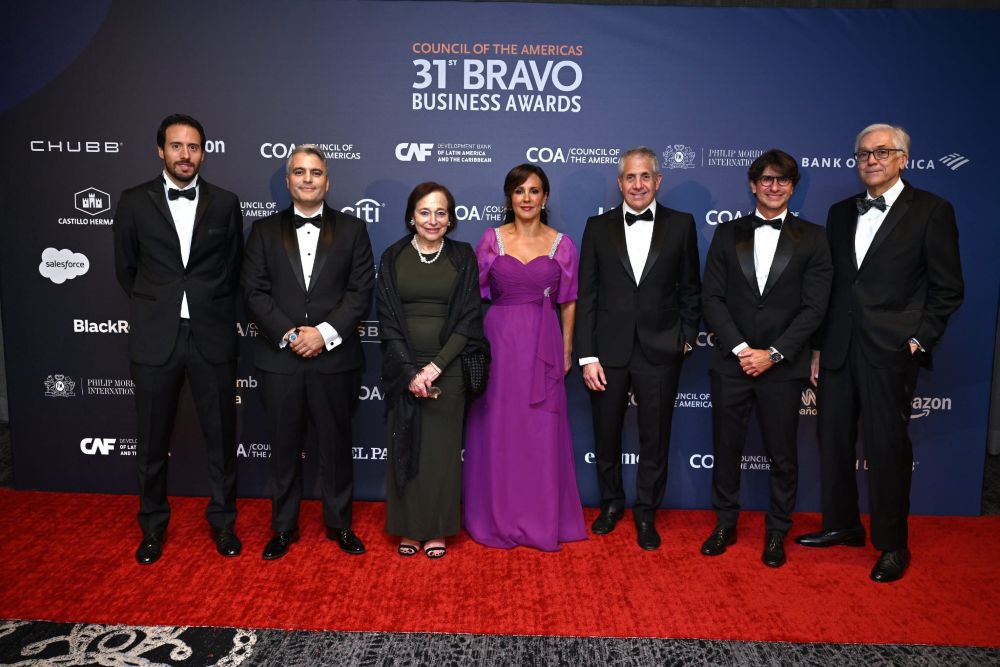
(L-R) Felipe Villamarin of Rappi, Carlos Barrera of Atlas Renewable Energy, Susan Segal and Maria Lourdes Teran of AS/COA, Roberto Alvo of LATAM Airlines, Francisco Lassalvia of Banco do Brasil, and Andrés Gluski of The AES Corporation and AS/COA. (Gort Productions)
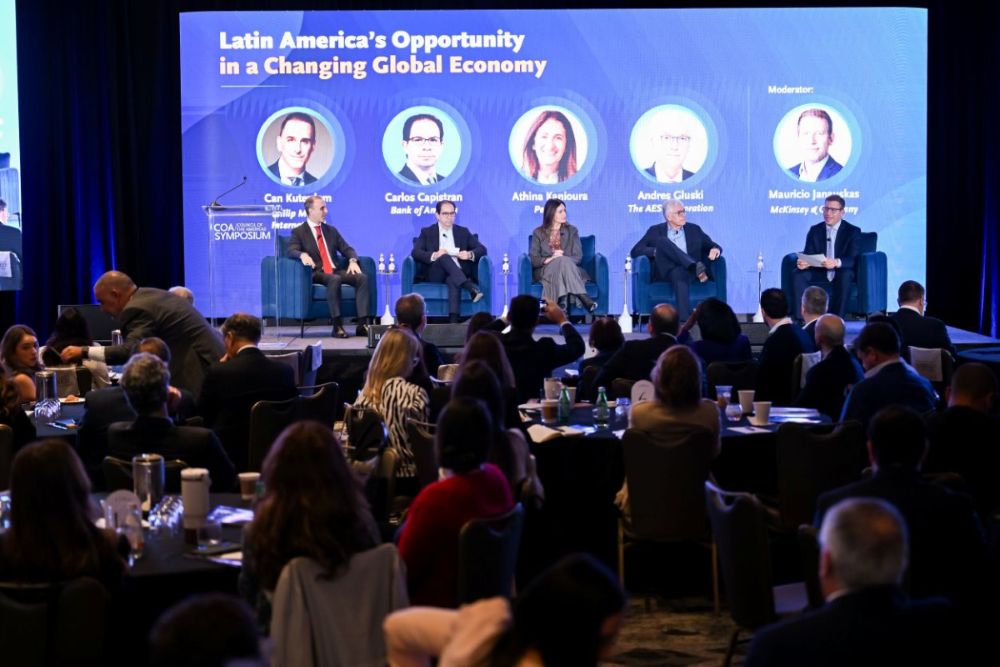
COA Symposium 2026. (Photo: Gort Productions)
COA’s BRAVO Business Awards recognized these firms and executives for having the vision to drive innovation and economic development across Latin America.
MIAMI, FL, UNITED STATES, November 20, 2026 /EINPresswire.com/ -- Council of the Americas (COA) held the 31st BRAVO Business Awards on November 19 at the Loews Coral Gables Hotel in Miami, honoring leaders and companies whose vision and achievements have driven innovation, expanded opportunities, and increased investment across the Americas."Latin America is not simply a market for global innovation. It is a source of it. Tonight, that tradition continues," said María Lourdes Teran, vice president of AS/COA Miami and chair of the BRAVO Business Awards. "Tonight's honorees represent very different chapters in that transformation, from a financial institution founded more than two centuries ago to companies reshaping how we generate energy, participate in the digital economy, and connect across borders. Their stories reflect the extraordinary ambition and ingenuity of Latin America's business community."
Roberto Alvo, CEO of LATAM Airlines, received the BRAVO CEO of the Year Award for his outstanding leadership in transforming LATAM Airlines during one of the most challenging periods in the aviation industry's history, leading the company through changes that strengthened its financial performance, accelerated its digital evolution and positioned it for long-term growth.
“I am deeply honored to receive the 2026 BRAVO CEO of the Year Award. This recognition reflects the commitment and resilience of the more than 44,000 people who make up LATAM Airlines Group across the region," said Alvo. "When I became CEO in March 2020, our industry was facing one of its most challenging moments. Together, we navigated a profound financial restructuring and laid the foundations for a stronger, more resilient company. Today, LATAM is achieving its strongest financial performance to date, while advancing its digital transformation and operational efficiency. I share this recognition with everyone who has been part of this journey and continues to help shape LATAM’s future."
Banco do Brasil was honored with the BRAVO Legacy Award, accepted by Francisco Lassalvia, its executive vice president and chief wholesale officer. As Brazil’s oldest financial institution and one of Latin America’s largest banks, Banco do Brasil was recognized for its longstanding contributions to Brazil’s economic, social, and sustainable development.
"For more than two centuries, Banco do Brasil has helped shape the future of Brazilians, both at home and around the world. Trust remains our greatest asset, built on consistency, transparency, and respect," said Lassalvia. "Since 2023, we have invested 26.2 billion reals in technology, empowering our people to embrace AI, and deliver more personalized, human-centered experiences. This is our Phygital strategy in action: combining the strength of our physical presence with the power of digital innovation. Receiving the BRAVO Legacy Award is a tremendous honor and a reaffirmation of our commitment to bringing together the strength of our legacy and the innovation needed to remain close and relevant to the people we serve.”
Rappi received the BRAVO Beacon of Innovation Award, accepted by one of its founders, Felipe Villamarín. The company helped pioneer the super app model in Latin America, reshaping how millions access goods and services while giving businesses new ways to grow.
"Since we founded the company, one of our most important missions has been to help people in Latin America believe and truly feel that world-class technology companies can be built in the region," said Villamarín. "And this award validates that innovation, perseverance, and the realization that, despite the many obstacles involved in building a company in Latin America, anything is possible."
Carlos Barrera, founder and CEO of Atlas Renewable Energy, was honored with the BRAVO Innovative CEO of the Year Award for his ability to turn the company he started in 2017 into the largest independent renewable energy producer in Latin America, helping accelerate the region's transition to a more sustainable future.
"It is an honor to be recognized as BRAVO Innovative CEO of the Year. At Atlas, innovation starts with a team willing to challenge how things are done. That culture has built the clean energy infrastructure powering many of Latin America’s leading companies. Our next interesting frontier is AI and data centers," said Barrera. "Latin America offers the two things the data center economy needs most: clean power at scale and speed to power. At Atlas, we intend to help the region seize the moment and continue partnering with large clients needing reliable power they can depend on. Thank you to the Council of the Americas for the important work you do in bridging the public and private sectors.”
Earlier in the day, over 500 company founders, industry pioneers, government officials, and regional leaders gathered at the COA Symposium to explore the theme, “Latin America’s Next Chapter: Growth, Investment & the AI Economy.”
The symposium explored key themes shaping Latin America’s future, including banking innovation, the expansion of Latin American companies in the United States, leadership during crises, and regional security risks.
AI was a central focus of the Symposium. Susan Segal, AS/COA's president and CEO, said that Latin America can be a builder in the AI economy, not only a user. "With some of the cleanest energy matrices in the world, the region is well positioned to host the data centers and power that AI requires," said Segal. "Companies here are already moving from pilots to putting AI to work across their operations."
As Latin America looks to translate growing AI adoption into economic opportunities, two panels examined the infrastructure needed to power the AI economy and how businesses can use the technology to gain a competitive advantage.
The panel "Powering the AI Economy: Latin America's Data Center Potential" explored the region’s potential to attract investment in data centers. Moderator Candela Macchi, head of Latin America Ratings & Research at Moody’s Ratings, highlighted the region’s advantages, including its renewable energy resources, while noting some of its challenges.
Ximena Rincón, minister of Energy of Chile, outlined three priorities the government is working on: providing certainty for investors, accelerating permits, and ensuring that the data processed also benefits the country. Regarding the potential of the entire region, Rincón said: “Latin America can take advantage of its wealth in renewable energy generation, gas, and diesel, transforming this territory into an opportunity for the world, but also for its own inhabitants.”
Following this conversation, a panel moderated by Alejandro Anderlic, director of Government and External Affairs for Latin America at Salesforce, focused on how the companies in the region can translate AI strategies into business value and competitive advantage.
"I think that this is the real first time in history where a continent like Latin America can actually leapfrog through technology," said Paula Bellizia, vice president for Latin America at Amazon Web Services. "Productivity is such an important outcome we want from our countries, and AI can be, if used right, can be what helps us to do that.”
Adam Kaufman, head of Industry Transformation at Anthropic, noted that Latin America is one of the fastest-growing regions for AI adoption and encouraged leaders to be early adopters, adding that that their example can influence how the technology is used across their organizations.
In a panel moderated by Mauricio Janauskas, managing partner for Spanish Latin America at McKinsey & Company, participants discussed how the region can overcome challenges and seize opportunities in a changing global economy.
Carlos Capistrán, head of Latin America and Canada Economics at Bank of America highlighted the importance of focusing on productivity.
"We need to make productivity a cornerstone of the agenda. We have to be dealing with productivity as if it were a crisis and we need to be delivering on that," said Capistrán. "That I think needs to be the question to be asked and this is what we need to be thinking about in the region."
Andrés Gluski, CEO of The AES Corporation, talked about the region's renewable energy potential and the need for consistent regulations.
"In the energy sector in itself, the issue is having consistent policies over time that allows investors to make low-risk returns that make it adequate to invest," he said.
The event also featured a conversation with Roberto Alvo, CEO of LATAM Airlines, moderated by Gabriela Frías, business anchor at CNN en Español. Alvo reflected on leading the company through the pandemic and its restructuring, emphasizing the importance of honest communication during a crisis.
A panel titled "Latin American Companies in the U.S. Market: Growth & Expansion," moderated by Julio Figueroa, CEO of Latin America at Citi, examined how Latin American companies have expanded across borders.
Roberto Lara, CEO of Castillo Hermanos emphasized that it's human-centered culture has helped the company to navigate challenges and expand into new markets. “This human-centric aspect is what has brought the company to where it is today […] and it is what will keep Castillo Hermanos growing in the future and especially in the U.S. now,” he said.
The Symposium also featured a leadership conversation with the 2026 BRAVO Business Awards honorees, moderated by Segal.
It continued with off-the-record sessions on security risks in the Americas, the digital transformation of Latin American consumers, and rebuilding Venezuela.
The conversation on Venezuela, moderated by Guillermo Zubillaga, head of the Venezuela Working Group at AS/COA, featured Xavier Prieto, country representative for Venezuela at CAF, among other participants, and focused on the investment and institutional conditions needed to rebuild the country.
The session on security risks featured Matías O’Farrell, vice president of corporate affairs for Latin America and Canada at Philip Morris International, alongside other panelists.
Juan Ignacio De Lorenzo, senior vice president and head of distribution for consumer lines at Chubb Latin America, and Adolfo Corujo, partner and managing director of strategy and AI at LLYC, joined the discussion on the digital transformation of the Latin American consumer. The session was moderated by Francisco Aldaya, panregional bureau chief at Bloomberg Línea.
Sponsors: Amazon, CAF–Development Bank of Latin America and the Caribbean, Chubb Latin America, LLYC, Philip Morris International, Bank of America, Castillo Hermanos, Citi, Moody's, Salesforce, The AES Corporation, BlackRock, FedEx, Grupo Mariposa, SBA Communications, Tower Strategy.
Knowledge Partner: McKinsey & Company.
Media Partners: Americas Quarterly, Bloomberg Línea, CNN en Español, El País, Exame.
Claudia Torrens
COA
ctorrens@as-coa.org
Legal Disclaimer:
EIN Presswire provides this news content "as is" without warranty of any kind. We do not accept any responsibility or liability for the accuracy, content, images, videos, licenses, completeness, legality, or reliability of the information contained in this article. If you have any complaints or copyright issues related to this article, kindly contact the author above.
